Who's afraid of Muslim Politicians?
We often associate campaigns and governance in the United States with some tried and true campaigning tactics. A candidate goes to state fairs, town halls, sets up tables at parades, and puts in other retail politics effort.
And yet, there has been a pervasive Orientalism that has followed Muslim politicians and candidates. Michigan Senate candidate Abdul El-Sayed, a veteran and medical doctor, has been the latest to bear the brunt of this treatment. Speaking at an event, education official Angie Smith said:
“We need someone that can represent all of us, not just one race… Don’t come out speaking only Arabic. Don’t come out with your Arabic music on.”
The assertion of Muslims as un-American tends to cross party lines in many troubling ways. It is irrelevant that El-Sayed is an American citizen that speaks English during campaign events or that he campaigns on the retail politics issues of affordability and constituent benefits most candidates do. All of this is overshadowed by the perceived threats of his stance on Israel and his ethnic identity. Ironically, the campaign of his primary opponent, Congresswoman Haley Stevens, has tried in vain to tie him to disgraced Maine candidate Graham Platner, who has been accused of sexual assault and rape by multiple women.
Let's take a moment to talk frankly, me to however many of you are reading this blog or email. Platner, who is white and ran as a populist, got a lot more leeway over moral and ethical conduct than someone who looks like. There is no way in this existence that someone like El-Sayed or Zohran Mamdani or Michigan Congresswoman Rashida Tlaib could sport the tattoos Platner did and still be a viable candidate for office. Even though Muslim candidates try to adhere to the conventions and cultures of American campaigning, they are not perceived as playing by the same rules.
Incumbent officials have not had it any easier, particularly Representative Ilhan Omar of Minnesota. On multiple occasions, she has been on the receiving end of threats of denaturalization and deportation by Trump himself. "She should go back" reads the Truth social post from Trump last November.
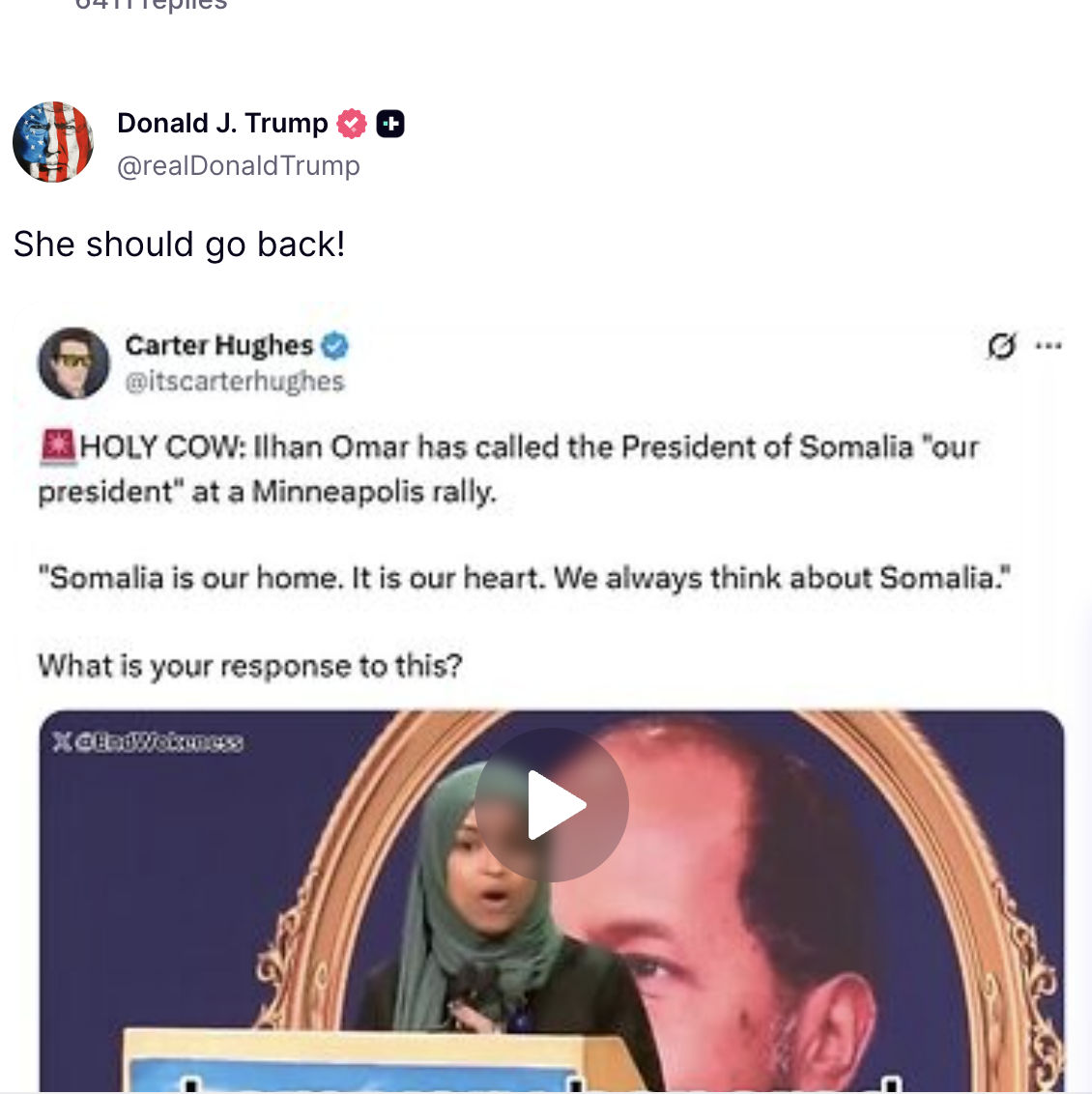
Omar, who is Somali, remains in the United States. To this day, she receives death threats with astonishing speed after Trump posts targeting her are published to social media. Others in her community have been threatened far more materially. The end of Somali protected status, cuts to Minnesotan welfare programs and other targeted harms have a clear message: they believe Muslims from Africa are committing welfare fraud and will suspend a wide swath of programs as a response.
The conditionality of Muslims' citizenship runs deep within the veins of American history and politics. Writing in Conditional Citizens, Moroccan-American author Laila Lalami recalls her citizenship ceremony in 2000, which was celebrated by her coworkers. They threw her a picnic with lemonade, burgers and all-American Apple pie.
One year later, after September 11, the about face from her white peers were about what we would expect. In a confrontation over a scheduling question, her software engineer coworker, who once served her a slice of apple pie, spat out: "What are you going to do, shoot me? Isn't that how you people solve things?"
The irony of this demanding question being issued by an American is not lost on me.
Within an international context, Islamophobia and its stereotypes use very similar language. Chinese treatment of Uyghurs and Turkic minorities, who are largely Muslim, was that they required guidance to work useful jobs and modernize their societies. Hence, prison labor and surveillance. In Europe, police attention to Middle Eastern and African immigrants occur as right-wing parties advised by white supremacists Steve Bannon and/or Elon Musk are growing. This global phenomenon has roots in the United States, but is constantly seeded and growing overseas as well.
That politicians like Omar, Mamdani and el-Sayed is simply the latest chapter in an already shameful sequence of American historical events. The stereotype of Muslims as lazy, dangerous and unassimilated is one that far too many Americans are eager to believe. We rightfully do not assume Jewish people are dually loyal to Israel and the United States. The same cannot be said for how Muslims are perceived and treated. El-Sayed's politics may be all American in ways consistent to any other campaign, but so is how he and every single Muslim politician in this country is hated and threatened.