The Chinese Worker and You

This international Labor day, I wanted to do a small post on the nature of work in contemporary China. Why?
a) I'm Chinese
b) I'm a worker
c) The work includes examining labor and work in China and its challenges in an era of globalization.
Most people think of Chinese workers rather stereotypically. Nine times out of ten, the Chinese worker is someone in a factory or textile manufacturing shop. The term "sweatshop" is commonly used.
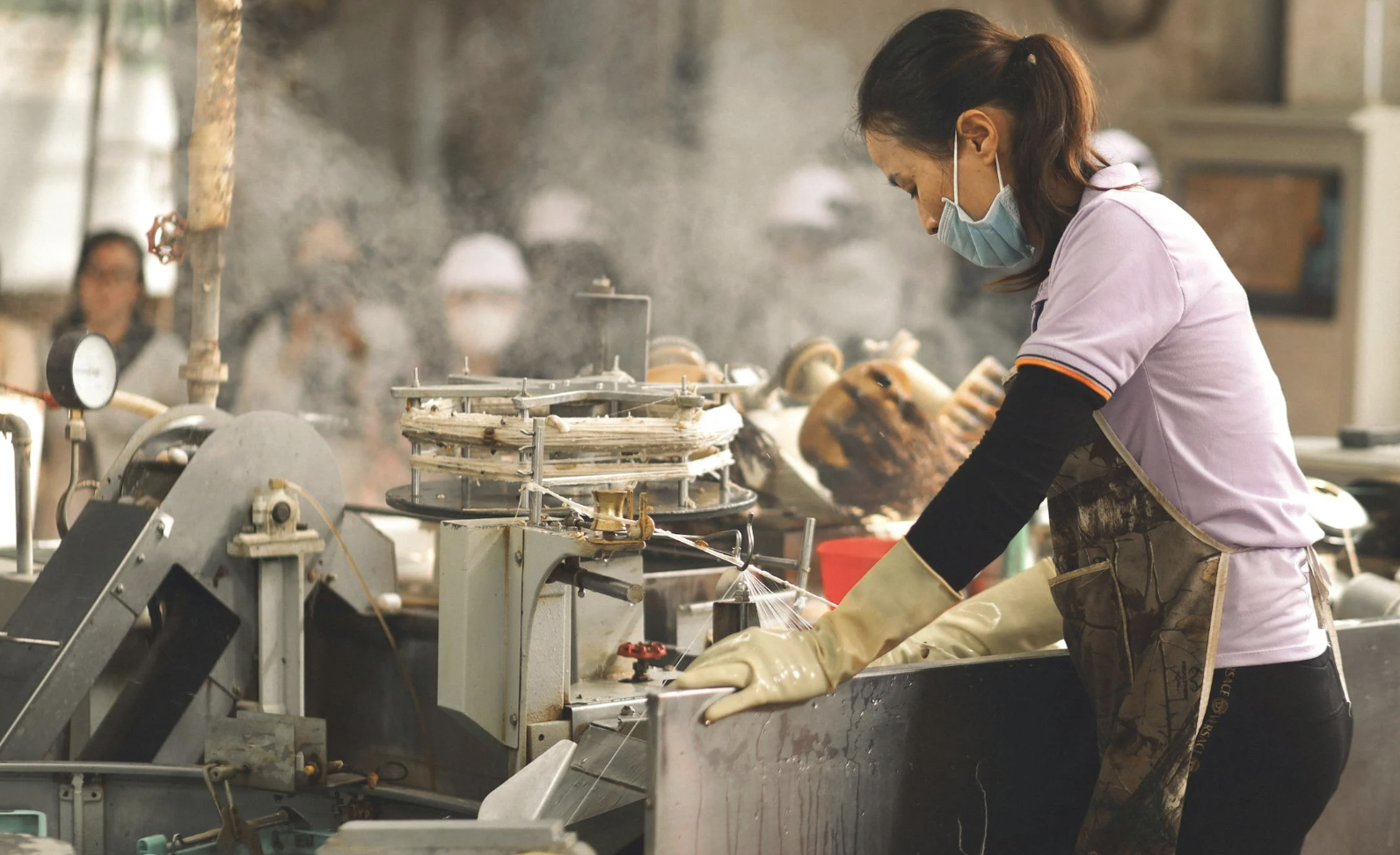
You may look at a photo like this and go "oh, that's a Chinese sweatshop." You'd be wrong. This textile shop photo was taken in Vietnam. Vietnam, Cambodia, Bangladesh and other South and Southeast Asian states are where a lot of textiles are being sewn now. However, the "made in China" slogan is something that's more or less permanently etched into the American mind, regardless of where stuff is actually made.
The other day I had a class with a professor who was discussing American innovation. He held up an iPhone and went: "this type of invention isn't discovered in a top-down authoritarian system." The implication was that American innovation paved the way for iPhones.
My immediate thought was: no, but you don't hold your iPhone at that price point without workers in that authoritarian system, combined with German, South Korean and Japanese components. And after that phone came out, Apple's CEO caved like a cardboard box at American and Chinese censorship requests.
This blog post isn't actually about Chinese workers making stuff for export, though. It's about discussing who makes up the Chinese workforce and what they're worried about.
Chinese workers can be split into two rough groups I will discuss. The first are white-collar, urban origin workers. They go to offices. They buy coffee and tea. They eat at decent-to-middling company cafeterias. Some of them go into lower-paying jobs if there is a shortage, layoff, or other employment crisis.
The second group are rural Chinese workers. Known as 农民/nongmin or peasants, Chinese political history reveres this group as the social masses that Mao was able to organize. They hold a cultural cornerstone in Chinese political history and culture, and one of China's biggest banks still pays homage to the agricultural worker. The word 'peasant' has a negative connotation in English, but 农民 is seen in a far more positive light because of the historical role they played.
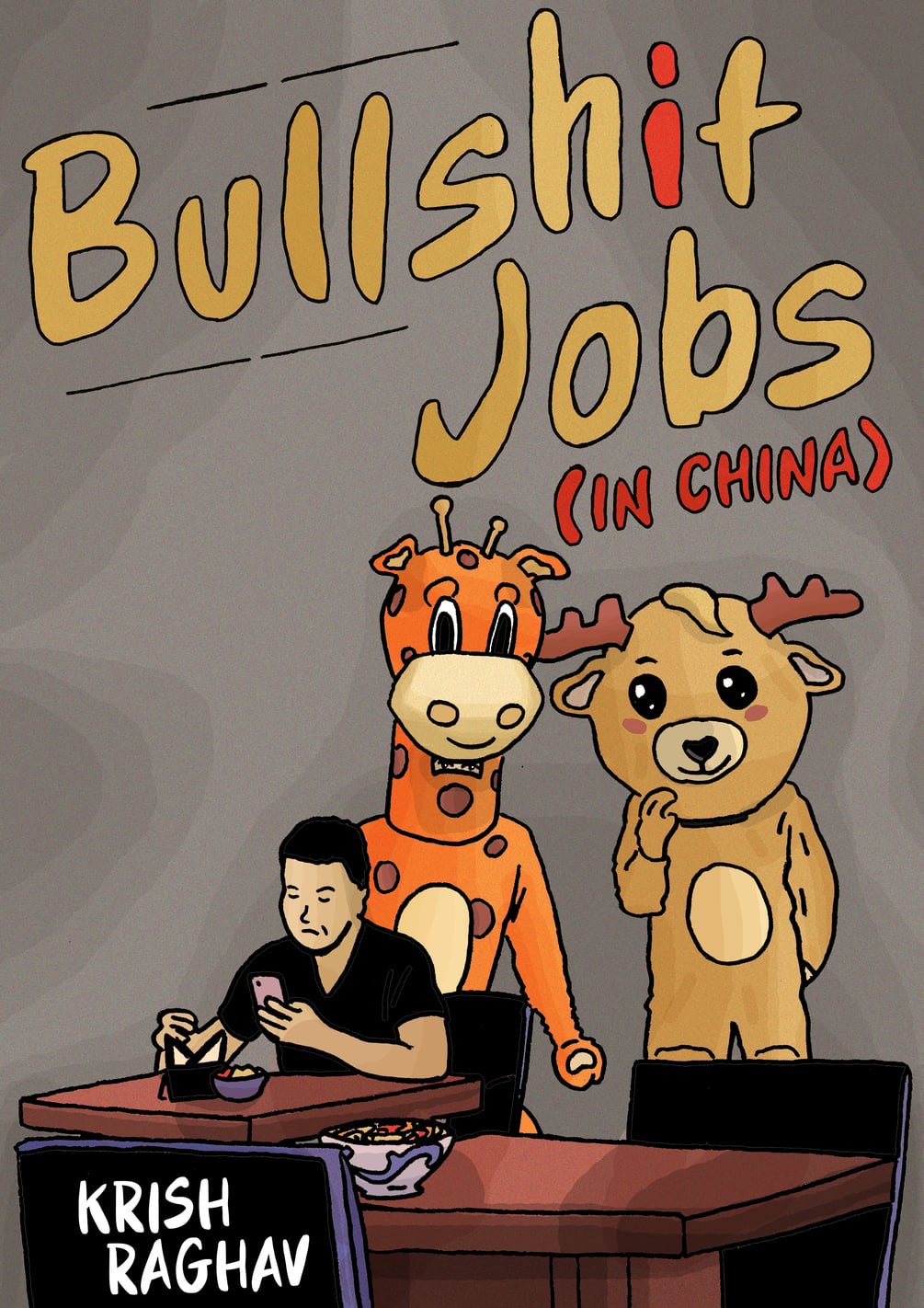
Unfortunately, homage is more or less all that rural workers get in this day and age. In cities, migrant workers power pretty much everything that white-collar workers enjoy. Known as 农民工 or migrant laborers, they travel thousands of miles outside of their hometowns, where there are no jobs, to do pretty much what city-dwellers are reluctant to do. This includes: cleaning, sweeping, trash pickup, delivery services, e-commerce fulfillment, and waiting in line. Yes, this is real. Artist Krish Raghav drew a comic detailing that task.
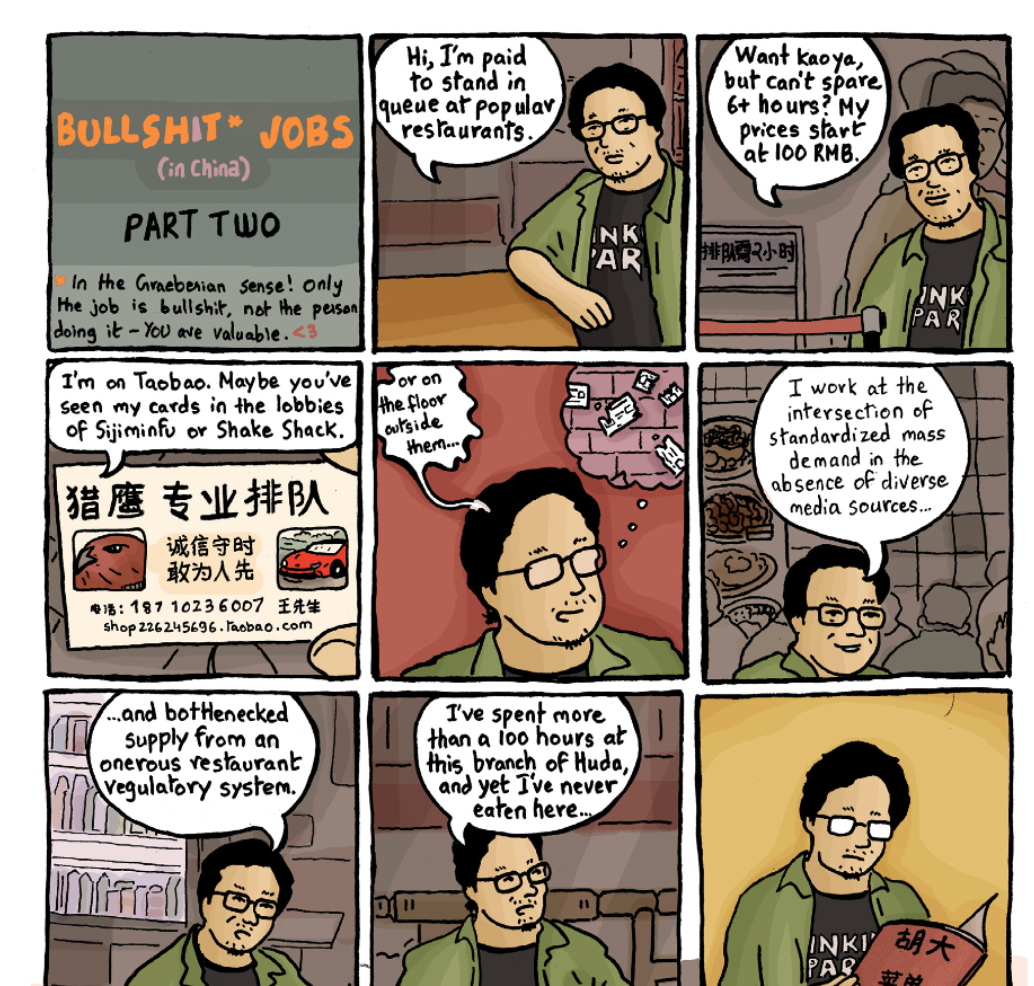
You can read this for however much you want to pay online.
This informal gig economy is behind a lot of China's cleanliness, neatness or otherwise efficiency that a lot of foreigners coo and bill over when visiting. But think of it this way. We know that AI does what it can nowadays because of workers in Kenya and the Philippines being exploited to do the rote tasks of users. The same goes for services in China, like reorganizing bikes left out by careless tourists.
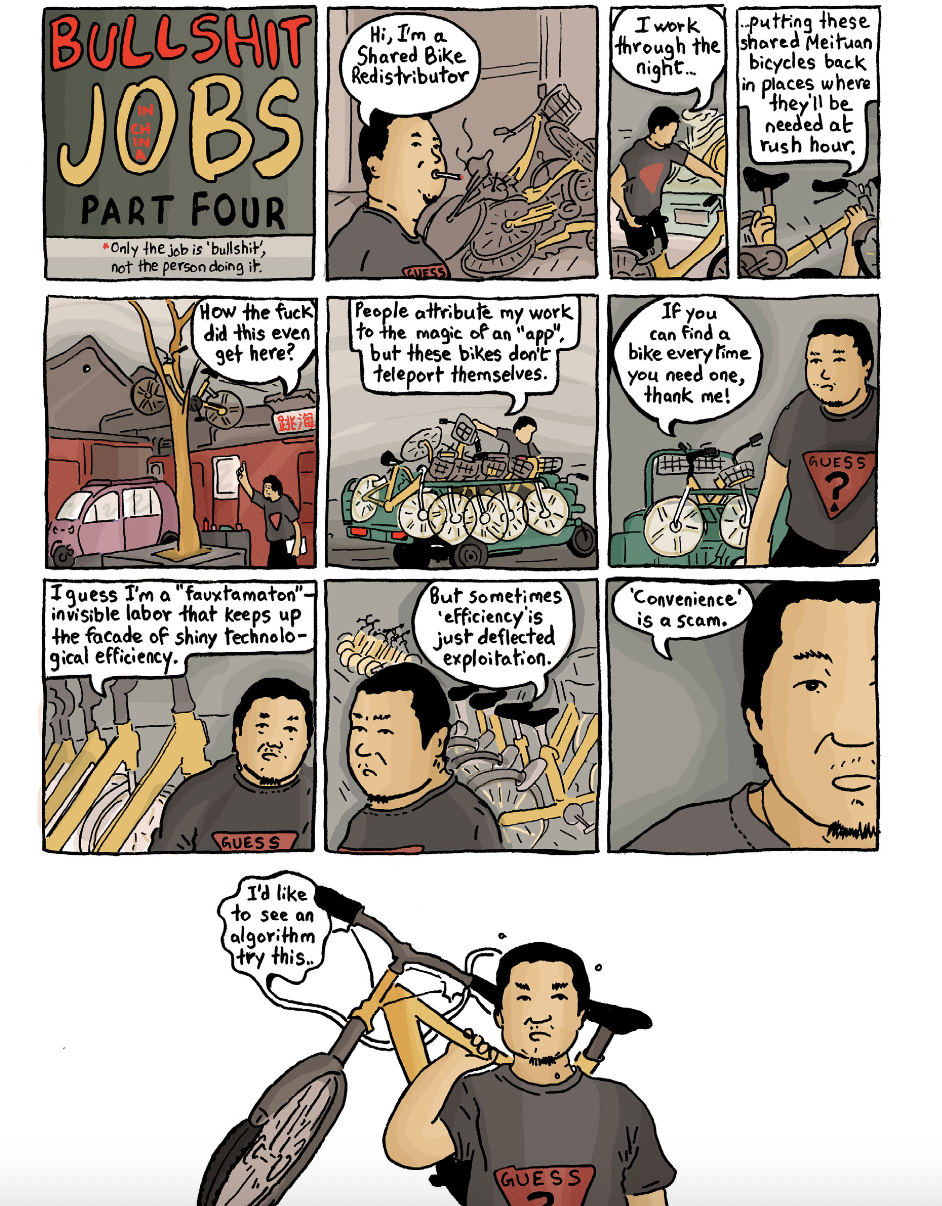
These workers have long and often inconsistent hours, very little in the way of recourse for poor treatment, and no guarantees of income even for services performed. They're also scrutinized by the police more than urban residents. Writer Xiaowei Wang offers additional snapshots into Chinese work and technology in Blockchain Chicken Farm. In Guiyang, a police officer named Xiaoli tells Wang how they monitor migrant workers closely. Why?
“The whole reason for this platform is because right now, Guiyang is developing fast, with so many migrants. And 80 percent of Guiyang’s migrants live in urban villages. And 70 to 80 percent of all Guiyang crime occurs in the urban villages. So what are we supposed to do? That’s why we have this platform, we have to register and track everyone. It’s for public safety.
If this suspicion sounds familiar and xenophobic, congratulations on the basic reading comprehension! The cops specifically use tracking and surveillance technology to monitor migrant workers that are already spending long hours in these menial jobs.
“We rely on the landlords, because we think a landlord would only like to rent to dependable people. But you never know. We have community police assistants that visit apartments during the day and at night. Many of the migrant workers do jobs that have night shifts. It’s hard to tell how many people live in a place. There’s some places crowded with bunk beds that allow double the capacity. Night workers sleep in the beds during the day, day workers sleep in the same beds at night."
I don't point to these stories to finger-wag at China or to imply that Chinese authorities are singularly bad and exploitative towards lower-income workers. China isn't special in that regard beause China isnt' the only participant in globalized capitalism. What I want to do this Labor day and every day is to demystify the idea that Chinese labor and Chinese labor dynamics are not understandable. That's just wrong.
If this is a critical time to understand China, we need to begin thinking about opportunities to think with internationalism rather than circlejerking about how America is the worst place ever. Yes, the trains are bad. Yes, we don't build subways very fast. However, tech CEOs love taking stuff from Chinese management that oppresses their white collar workers: 996 work shifts, for example. Make-up work days are another trend that probably is on the way in. Livestream e-commerce has caught on in the United States, leading to the rise of temu and Amazon hauls overloading delivery services with cheap knick-knacks.
All of these exploitative practices do not emerge from nowhere. Rather, they have geographic and political contexts in very specific sectors of China. Out of respect for the Chinese workers that have gone through these forms of exploitation first, we have long owed them the time and effort required to learn their stories.
Further reads:
Blockchain Chicken Farm by Xiaowei Wang





闯 Chuǎng will publish a journal analyzing the ongoing development of capitalism in China, its historical roots, and the revolts of those crushed beneath it. Chuǎng is also a blog chronicling these developments in shorter and more immediate form, and will publish translations, reports, and comments on Chinese news of interest to those who want to break beyond the bounds of the slaughterhouse called capitalism.